
City in Thai drug web
OB Bureau
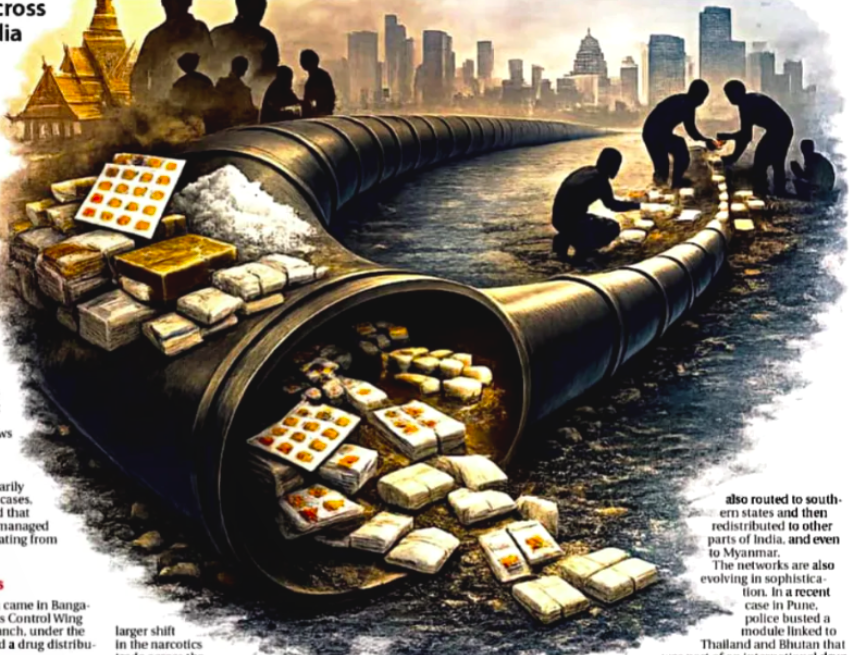
A drug trail stretching from Southeast Asia to the streets of Bangalore has now caught the attention of investigators and the city has emerged as one of the latest flashpoints in a widening narcotics network.
Probes into multiple drug cases across India have revealed a growing link to cartels operating out of Thailand. Investigators say these networks are steadily tightening their grip on South India, with their influence expanding over the past few years.
What is raising eyebrows among enforcement agencies is that many of these operations in Thailand are not necessarily run by locals. In several cases, investigators have found that the networks are being managed directly by Indians operating from there.
Key Bangalore arrests
The latest breakthrough came in Bangalore, where the Narcotics Control Wing of the Central Crime Branch, under the Bengaluru Police, busted a drug distribution module.
Two interstate peddlers, identified as Ashwin and Mubeena, were arrested after police seized LSD strips and charas from them. The duo, originally from Kerala, had been living in Bangalore for about a year and were allegedly running an illegal distribution network across Karnataka.
Preliminary investigations suggest the pair were operating on instructions from handlers based in Thailand. Police said the accused were in touch with a Kerala-based operative stationed there, who supplied the drugs. Once the contraband reached them, it was distributed across the state.
Investigators say the pattern reflects a larger shift in the narcotics trade across the country. While Punjab once dominated headlines as India’s drug hotspot, enforcement agencies say the market has rapidly expanded in southern states in recent years.
Where is it coming from?
Figures from 2024 highlight the scale of the challenge. More than 27,700 cases were registered in Kerala under the Narcotic Drugs and Psychotropic Substances Act that year, nearly three times the number recorded in Punjab during the same period.
According to officials, global cartels are increasingly dividing the Indian market by geography. While Pakistan-based operators largely focus on northern states, networks linked to Mexico, China and Thailand have been targeting southern India.
States such as Kerala and Tamil Nadu have emerged as key entry points for narcotics shipments. Drugs arriving from Thailand commonly include LSD, charas and cocaine. Methamphetamine sourced through networks linked to Mexico, Chinese cartels and Myanmar nationals is also in high demand across southern states.
Kerala has become a preferred landing point for these consignments, officials say, largely because of its 590-km coastline that makes smuggling easier. From there, drugs often move into neighbouring states including Tamil Nadu and Karnataka before spreading further across the country.
Investigators say shipments that land in the Andaman and Nicobar Islands are also routed to southern states and then redistributed to other parts of India, and even to Myanmar.
The networks are also evolving in sophistication. In a recent case in Pune, police busted a module linked to Thailand and Bhutan that was part of an international drug peddling syndicate.
Five people were arrested, and investigators found that the group used the dark web, hawala channels and cryptocurrency to purchase LSD and marijuana before routing the drugs into India.
Who’s watching?
An official from the Intelligence Bureau said the Indian narcotics market has become increasingly crowded.
“For years agencies focused on the syndicate linked to Dawood Ibrahim,” the official told the press, adding, “Today there are multiple players, including Thailand-based cartels with Indian bosses, trying to flood the market with drugs.”
With Bangalore now appearing on the radar of these international networks, enforcement agencies say they are working closely with state and national counterparts to track the supply chains and stop the city from becoming a bigger hub in the expanding drug trade.
***With inputs from agencies