
In 2026, Gen Z redraws rules
HL: In 2026, Gen Z redraws rules
Strap (Page 1): From burnout to balance, Gen Z spells out what Bangalore must fix, rethink and prioritise in 2026
Strap (Page 8&9): A generation raised connected tells Bangalore how to balance ambition, empathy and accountability in 2026
Byline: Bhuvana Shridhar
It’s 2026, and the ground beneath Bangalore’s feet is already shifting. Like it or not, the year has arrived with Gen Z firmly in the driver’s seat – alert, articulate and allergic to old rules that no longer serve.
The signals were unmistakable in 2025. Beyond tumbling governments and flash-in-the-pan trends, a sharper generation began asserting itself. They’re questioning power, demanding accountability and refusing to be background noise. This is a cohort that grew up online, thinks in data, lives its politics daily and expects institutions to keep up.
In the years ahead, their imprint will be impossible to dodge. Politics, workplaces and culture are already bending. From boardrooms to classrooms, cafés to co-working spaces, Gen Z’s influence is visible in how work is negotiated, how causes are chosen and how conversations are framed. They arrive armed with lived experience, research-backed arguments and an unapologetic insistence on being heard.
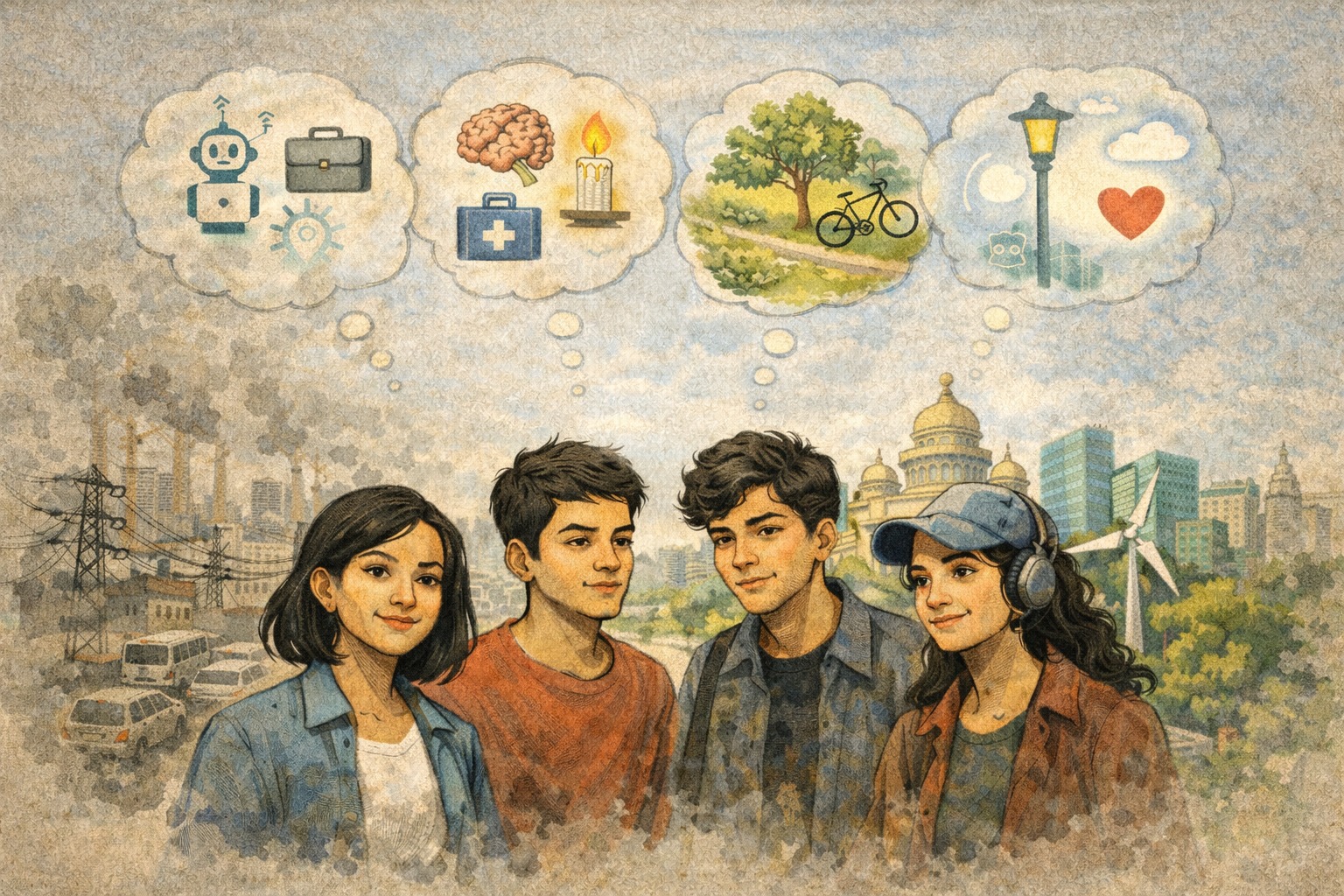
Against this backdrop, Our Bangalore reached out to voices from the generation to ask a simple question – what should 2026 look like? The answers cut across anxieties and ambition – Artificial Intelligence and jobs, mental health and burnout, climate crisis, personal safety and the right to breathe easier in a restless city.
Taken together, these aspirations sketch a Bangalore Gen Z wants to shape; a city that is fairer, safer, smarter and unmistakably their own. Read on…
‘We’re wary of hustle culture’
For Bharatesh Patel, Head of Student Services at S-VYASA University, Bangalore’s Gen Z is often underestimated. “Bangalore’s Gen Zers are matured, and their expectations are clearly defined. We are wary of the hustle culture that impacted previous generations. We want job security and better work-life balance,” he says.
In a city once synonymous with sleepless startups and glorified burnout, this is a significant shift. Bharatesh says young professionals are no longer impressed by long hours masked as ambition. “We need empathetic leadership; corporates that retain talent instead of being consumed by management politics,” he adds.
On artificial intelligence (AI), Bharatesh strikes a balanced note. He supports its adoption but warns against shallow implementation. “AI is welcome, but IT companies must offer sufficient hands-on training to freshers. A great motivation is where skills stick, boost employability, and turn freshers into pros,” he says.
The missing link, he believes, lies between academia and industry. “When institutions level up, blending theory with hands-on skill sprints and industry collaborations; freshers will be job-ready. They will be game changers,” he says.
“It’s no longer about whether machines can”
For Indu Suresh, a student at Alliance University, 2026 represents a turning point rather than a reset. “The future belongs to Gen Zers who aren’t afraid to innovate, disrupt and make their mark,” she says, viewing technology not as a threat but a tool that demands responsibility.
“Working with AI and machines, not against them, is the real challenge,” Indu explains. “The question is no longer whether machines can do what we do, but if they can, how far should we let them,” she adds. With quantum innovation edging closer to mainstream adoption, she believes resistance is futile. “It’s not a matter of if, only when,” she asserts.
But empowerment, Indu insists, must move beyond slogans. “Progress has to be fair, humane and shared,” she says, stressing that inclusion must translate into real systems.
“In an inclusive society, women must have equal access to work rights, fair opportunities, safe workplaces and policies that support work-life balance. Real freedom lies in empowering young women with equal opportunities. It’s a voice that matters and zero tolerance for bias,” she adds.
‘Normalise mental healthcare’
Kabeesh Maruthai, also a student at Alliance University, frames 2026 as an opportunity to rethink how cities function. “My vision is AI-driven innovation with urban spaces that prioritise eco-friendliness and inclusivity,” he says, calling for technology to drive social change rather than deepen divides.
Mental health, for Kabeesh, is central to this transformation. He believes technology can reduce stigma rather than amplify stress. “High-tech alternatives like teletherapy and mental health apps offering confidential counselling should be integrated. By doing that, mental healthcare becomes accessible and stigma-free. It’s as normal as grabbing a coffee,” he says.
Education and careers, he predicts, will undergo a reset. “Degrees will matter less than proof-of-work. Live portfolios, projects and digital credibility will define hiring decisions,” Kabeesh says.
He also advocates lifestyle changes in a hyperconnected city. “Silent cafés, phone-free zones and digital detox spaces can encourage healthier habits. If integrated well, Bangalore can become smarter, slower and more meaningful,” he says.
‘Safety is non-negotiable’
For Adithi Kotapati, a CA aspirant, 2026 comes with firm expectations, particularly from a city that brands itself as India’s innovation capital.
“Bangalore should grow not only as a technology hub but as a balanced, compassionate city,” she says. Her priorities are clear – careers, mental health, ethical AI and women’s safety.
“Safety and order are non-negotiable. Young women deserve a secure environment. We cannot and will not compromise on equal opportunities,” Adithi stresses.
She also flags the rising mental health concerns among youth. “Educational institutions must create safe spaces. An open-door policy helps young people feel comfortable sharing problems and seeking support,” she says.
By the end of 2026, she hopes the city moves beyond symbolic gestures. “Workplaces, colleges and institutions must provide genuine support such as accessible counselling and leadership rooted in empathy,” she adds.
On AI, Adithi calls for balance. “AI should boost productivity without replacing human judgment,” she says. “Bangalore should lead by harmonising innovation with accountability,” she adds.
And the basics still matter. “Better infrastructure, well-lit roads and safer public transport are long overdue,” she adds.
“Mental health should not be something we whisper about”
For Gayathri, 2026 represents “hope, correction and growth”. “Mental health is deeply personal to me. Academic pressure, social media comparison and the fear of not being ‘enough’ affect young minds quietly,” she says.
She wants those conversations brought into the open. “Mental health should not be treated as a myth,” Gayathri insists, saying, “Schools, colleges and workplaces must normalise discussions around stress, anxiety and self-worth.”
On AI, she draws a clear ethical line. “The future is not about machines becoming smarter than humans. It’s about humans using technology wisely,” she says.
Her hope for young women is simple but powerful. “To dream without limitation. To choose careers and identities without fear of judgment, and to live without being restricted by stereotypes,” she says.
‘The climate crisis is call to action’
Dhruv, a Bangalore-based Gen Zer, sees 2026 as a test of intent. “We’re a generation focused on flexibility, work-life balance and constant learning. We want jobs that evolve with us and allow us to make a difference,” he says.
He points to peers already experimenting with GenAI, quantum computing and blockchain. But technology alone, he says, isn’t enough. “Bangalore needs more green spaces beyond Cubbon Park and Lalbagh,” Dhruv argues. “We must reduce carbon footprints and embrace a circular economy,” he asserts.
For Gen Zers, he adds, climate change is immediate. “It’s not a buzzword; it’s a call to action.” Responsibility, he believes, must be shared. “Change cannot rest with the government alone. Citizen–government collaboration is essential,” he concludes.