
The ‘spy’ seagull mystery
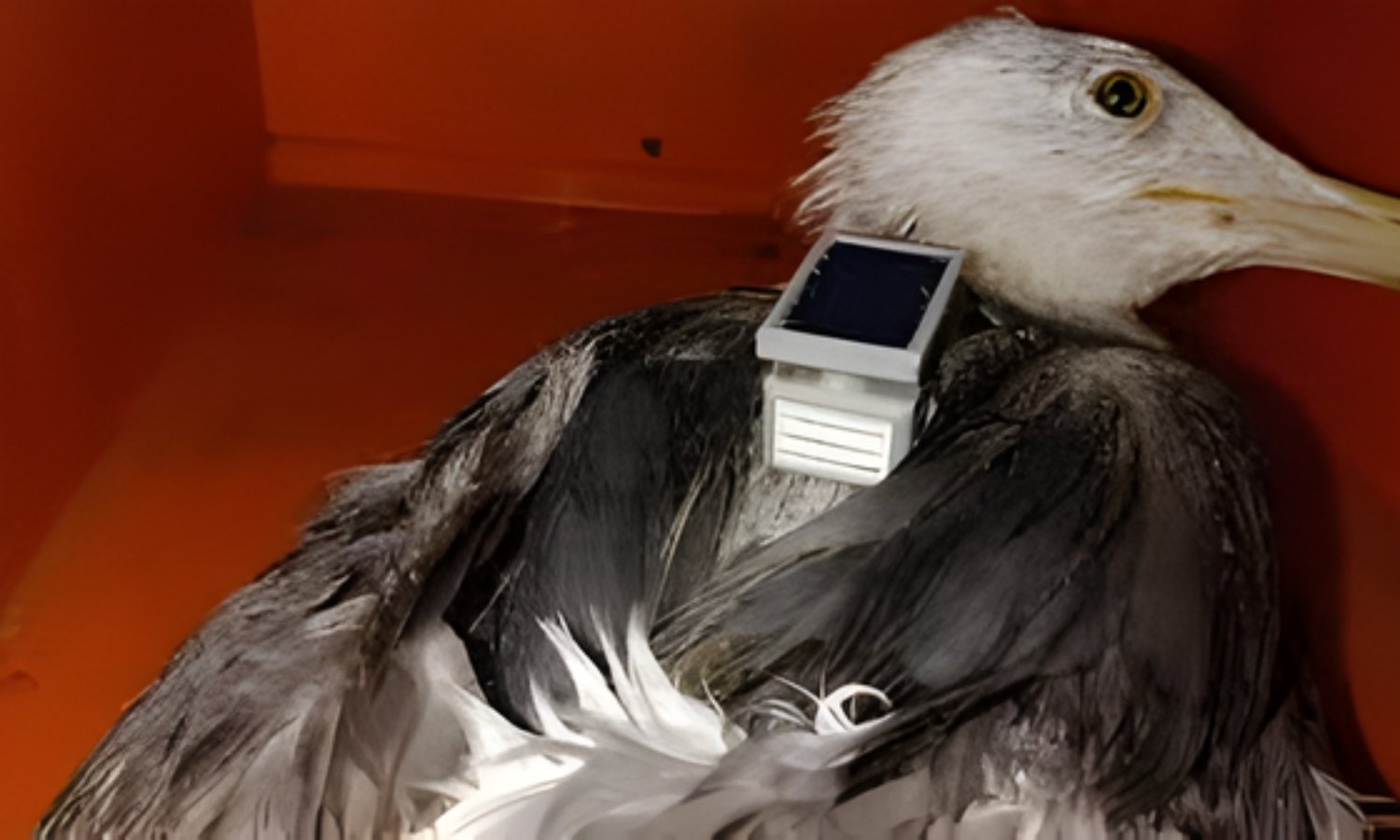
Strap: A tracked seagull’s landing near INS Kadamba in Uttara Kannada sparks whispers, suspicion & a coastal scar
Blurb
The device was a Chinese-made GPS tracker, carefully tied to the bird, with a note attached asking anyone who found it to contact an email address
Byline: Ravi Kiran
It began like a scene straight out of a spy thriller; just that, the suspect had wings. On a quiet stretch near Karwar’s coastline in Uttara Kannada, local residents spotted an injured seagull resting behind the Thimmakka Garden area.
At first glance, it looked like just another tired migrant washed up after a long flight. But strapped to its back was something that didn’t belong in the wild. It was a strange electronic device with a small solar panel. In a region shadowed by naval radar and security patrols, that was enough to raise alarms. Within hours, whispers of a “spying bird” were flying faster than the seagull ever could.
Sensing trouble, residents alerted the forest department’s marine division. The Coastal Marine Police Cell at Rabindranath Tagore Beach stepped in, safely capturing the bird and handing it over to forest officials, media reports suggested. What they found only deepened the mystery – the device was a Chinese-made GPS tracker, carefully tied to the bird, with a note attached asking anyone who found it to contact an email address.
And then came the detail that turned curiosity into concern. The bird had been found close to INS Kadamba, one of the Indian Navy’s most strategic installations. Suddenly, this wasn’t just about wildlife.
High-security waters
INS Kadamba is no ordinary naval base. It houses key warships, including aircraft carriers and submarines, and after its ongoing expansion, it is set to become the largest naval base in the eastern hemisphere. A GPS-enabled device landing this close to such a sensitive zone was enough to trigger a multi-agency response.
A joint inquiry was launched involving forest officials, local police and naval authorities. Every angle was examined. Was this an innocent research project gone astray or something more unsettling? The plot thickened before it calmed.
During preliminary checks, authorities traced the email address on the device to the Research Center for Eco-Environmental Sciences under the Chinese Academy of Sciences (CAS) in Beijing, according to a news agency. The revelation added an international dimension to what had already become a local sensation. However, early findings began to cool the espionage fears.
Police said the tracker appeared to be designed to study migration routes, feeding patterns and movement behaviour of seagulls; a globally accepted scientific practice. “At this stage, there is no evidence to suggest any espionage activity,” officials were quoted as saying in the press, stressing that GPS tagging is widely used in wildlife research.
Data retrieved from the tracker offered another clue. According to a Times of India report, the seagull had flown more than 10,000 km, travelling across Arctic regions before finally reaching the Karnataka coast. That journey, scientists say, aligns with known migratory behaviour rather than covert surveillance.
“Several angles are being examined, including whether the bird was part of a scientific research project to study migratory patterns,” Uttara Kannada Superintendent of Police Deepan MN was quoted as saying by NDTV. The device, officials added, would be sent for detailed technical examination to rule out any other possibilities.
Where is the ‘winged-spy’?
For now, the seagull has been shifted to the Marine Forest Division office for observation. Officials are trying to formally contact the research institution to confirm the origin, timeline and scope of the tracking programme, and to understand whether the device transmitted any data beyond routine location tracking.
Importantly, this isn’t the first time Karwar has found itself at the centre of a “spy bird” scare. In November last year, a war eagle fitted with a tracking device was spotted within the limits of Baithkol port. That case, too, was eventually linked to legitimate wildlife research. Still, authorities aren’t taking chances.
“While wildlife tracking using GPS devices is a globally accepted scientific practice, the location where the bird was found makes it imperative for multiple agencies to verify all aspects,” police told the press, underlining the strategic sensitivity of the coastal region.
Officials have also urged the public and media to avoid spreading misinformation. They reiterated that GPS tagging helps scientists understand migration routes and bird behaviour, and such studies are crucial for conservation planning.
Verdict so far
What began as a moment of suspicion on a Karwar beach has now turned into a reminder of how far migratory birds travel and how modern science follows their journeys. The bird that briefly stirred fears of espionage now appears to be just another long-distance traveller, carrying data for science, not secrets for spies.
In an age where surveillance anxieties run high, even a seagull can spark a security scare. But for now, the verdict is clear – this was a case of wings over worry; not war.
BOX – I
Previous ‘spy animal’ scares
- Karwar, 2024: A war eagle fitted with a tracking device was spotted near Baithkol port; later linked to wildlife research.
- Mumbai, 2023–24: A pigeon found at Pir Pau Jetty with rings and Chinese markings was held for eight months before being identified as a racing bird from Taiwan and released.
- Kashmir, 2020: Police released a pigeon belonging to a Pakistani fisher after ruling out espionage.
- India, 2016: A pigeon was taken into custody after a note threatening the Prime Minister was found attached.