
NEWS AT A GLANCE
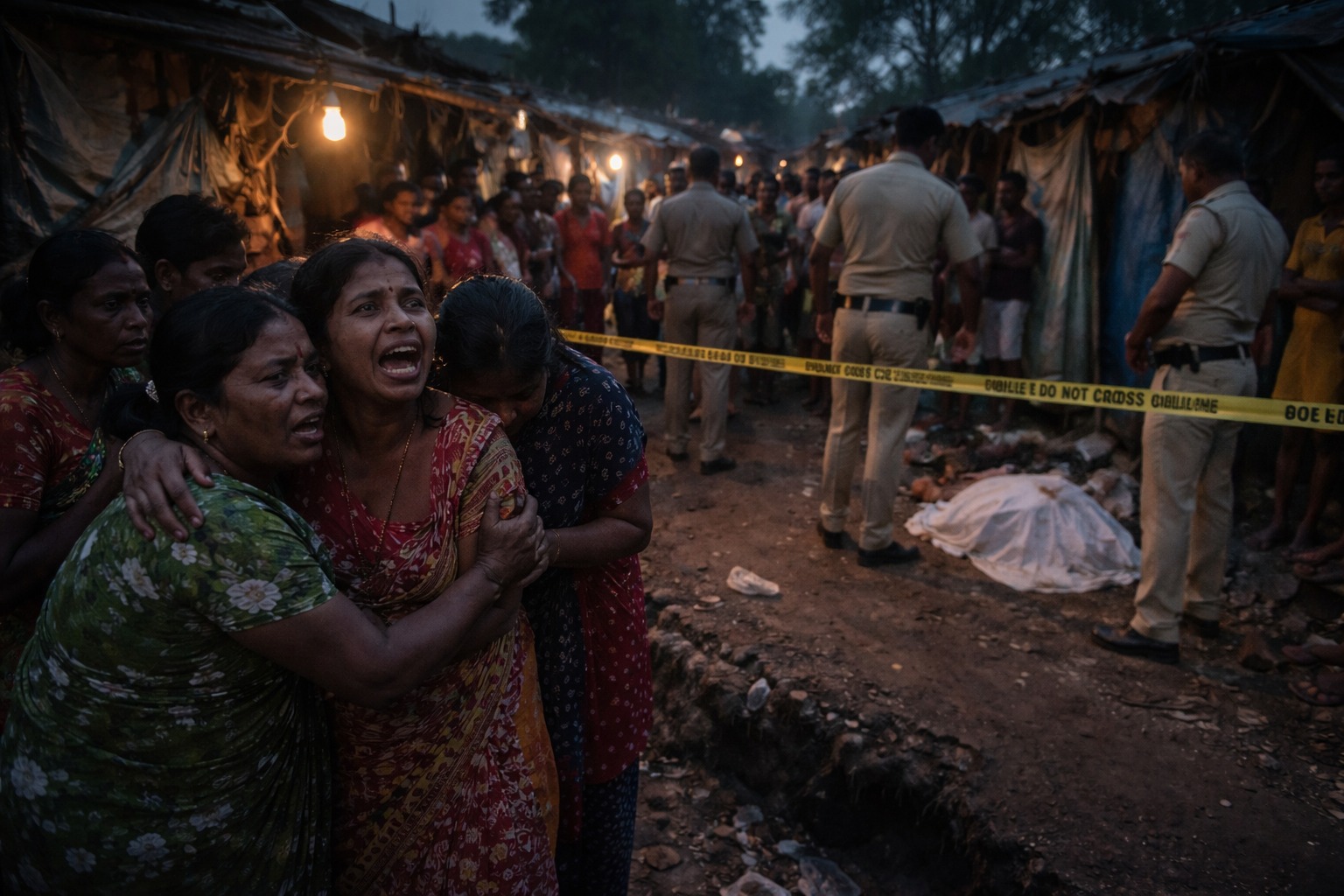
HL: Whitefield Horror: 6-yr-old dead in drain
OB Bureau
A migrant colony near Whitefield was gripped by shock and grief midweek after a six-year-old girl was allegedly abducted and murdered.
According to police, the victim was the daughter of a migrant worker from West Bengal, living with her family in a makeshift settlement at Pattandur Agrahara. The child went missing while playing near her home, setting off frantic searches by her parents and neighbours.
When the girl failed to return, her family combed the area before approaching the Whitefield police the next day. In his complaint lodged on January 6, the girl’s father suspected the role of a man who lived nearby, who is also a migrant worker from West Bengal. He told police that the man had been seen in the vicinity of their house around the time the child was last seen playing outside.
The search ended in tragedy when the child’s body was found in a dry drain close to the migrant colony. The discovery sent waves of fear through the tightly packed settlement, home to several daily-wage workers and families living on the margins of the city.
Police said preliminary findings suggest the girl was strangled to death. They clarified that there were no signs of sexual assault on the body. The exact motive behind the killing is yet to be established, and investigators are continuing to examine all possible angles.
Based on the family’s complaint, the Whitefield police have registered a case and launched a full-scale investigation. The suspect named by the family is currently at large, and police teams are conducting searches to trace and arrest him.
The incident has cast a harsh spotlight on safety concerns in Bangalore’s fast-growing outskirts, where migrant communities often live with limited security. In Pattandur Agrahara, fear now lingers, with parents keeping children close and residents demanding swift action. As the investigation continues, a grieving family waits for justice and answers.
HL: Eyes on the stripes: K’taka tiger census begins
Strap: Phase one tracks carnivores, phase two counts prey, phase three sets cameras to decode Karnataka’s big cat numbers
OB Bureau
Karnataka’s forests are back under the scanner; not for threats, but for stripes. The state has kicked off its latest tiger and carnivore estimation exercise, a massive ground-level operation that will sweep through every forest range in state, from dense tiger reserves to far-flung divisions.
Forest, ecology and environment minister Eshwar Khandre said the exercise marks the sixth round of the nationwide tiger census, held once every four years.
This time, the count spans all major tiger landscapes in the state, Kali, Bhadra, Nagarahole, Bandipur and the Biligiri Rangaswamy Temple (BRT) Tiger Reserve, along with patrol areas across all 38 forest divisions. Karnataka, which last clocked an estimated 563 tigers and ranked second nationally, is keenly watching the numbers again.
Speaking to the press, Khandre said extensive groundwork had gone into the exercise. From October to December, frontline staff from the five tiger reserves and personnel from all 13 forest circles were trained to ensure uniform data collection across terrains.
The first phase began on January 5. Teams of three forest personnel each are trekking around five kilometres a day for three days in forest areas, gathering crucial evidence — pugmarks, scat samples and direct sightings of tigers, leopards and other carnivorous animals, along with elephants. Every footprint and sighting feeds into a larger picture of Karnataka’s wildlife health.
A second phase is scheduled from January 15 to 17 across 14 forest divisions. This round shifts focus to herbivores, deer, sambar, gaur and wild buffalo, whose numbers determine prey availability and, ultimately, how many big cats a forest can sustain. The data will also guide where camera traps should be installed.
Overseeing the entire operation is Tiger Project Director Ramesh Kumar, appointed nodal officer to the National Tiger Conservation Authority (NTCA). His brief is wide-ranging – assess carnivore numbers, map prey populations, evaluate food availability and determine the carrying capacity of each forest.
The third phase will see camera traps deployed based on insights from the first two rounds. Karnataka currently has 2,230 camera traps across its five tiger reserves, with surveys already underway. Nagarahole leads with 600 cameras, followed by Bandipur (550), Kali (450), Bhadra (330) and BRT (300).
Camera traps are also being extended beyond core reserves. Bandipur will support Cauvery Wildlife Sanctuary, BRT will aid M M Hills, while Nagarahole will supply cameras to the Madikeri Wildlife Division and the Mysuru Regional Division.
Khandre noted that tigers are increasingly straying into human habitats, suggesting a growing population. The exact picture, however, will emerge only once the exercise concludes.
HL: Bangalore expressway hits Guinness World Records
OB Bureau
The Bangalore–Kadapa–Vijayawada Expressway, a key highway project that promises to redraw the city’s connectivity map, has delivered two Guinness World Records during construction in Andhra Pradesh.
The feat, achieved by the National Highways Authority of India (NHAI), puts Bangalore right at the centre of one of the country’s most ambitious expressway corridors.
Andhra Pradesh Chief Minister N. Chandrababu Naidu revealed midweek that NHAI, through contractor M/s Rajpath Infracon Pvt. Ltd., laid an astonishing 28.95 lane-kilometres and 10,675 metric tonnes of Bituminous Concrete continuously within 24 hours on the Bangalore–Kadapa–Vijayawada Economic Corridor (NH-544G). The work, he said, was executed in full compliance with NHAI’s quality standards.
The six-lane, access-controlled expressway is designed to slash travel time between the city and Andhra Pradesh’s capital Amaravati from the current 11–12 hours to nearly six hours. Once completed, the corridor is expected to significantly ease passenger movement, freight flow and logistics between Karnataka’s tech capital and the east coast.
The expressway will bypass congested towns and existing highways, offering uninterrupted, high-speed travel. From Bengaluru, it heads through Andhra Pradesh’s Guntur, Prakasam, Kurnool and Kadapa districts, stitching together industrial hubs, agricultural belts and emerging growth centres.
Taken up under Bharatmala Phase-II, the project blends greenfield and brownfield stretches to maximise speed and efficiency. The total length is estimated between 518 and 624 km, with an overall investment of about Rs 19,200–Rs 19,320 crore.
The greenfield section spans roughly 342 km from Kodikonda to Addanki/Muppavaram, while brownfield upgrades include the Bengaluru–Kodikonda stretch of 73 km on NH-44 and Addanki–Vijayawada’s 113 km on NH-16.
As construction gathers pace and records tumble, the message for Bengaluru is clear: a faster, smoother highway link to Andhra Pradesh — and beyond — is no longer just on the drawing board.