
The 2 am food fix
Byline: Sarwar Borah
In Bangalore, sleep is often deferred, negotiated with, or abandoned altogether. Long after office towers go dark and residential streets fall silent, the city continues to breathe through its late-night food joints.
For night owls – be it the certified insomniacs, night-shift workers, tech employees working across time zones, students, journalists, designers, freelancers, you name it! – these places are not accidental discoveries. They are known, relied upon and returned to, night after night. Late night eating here is not about craving. It is about continuity.
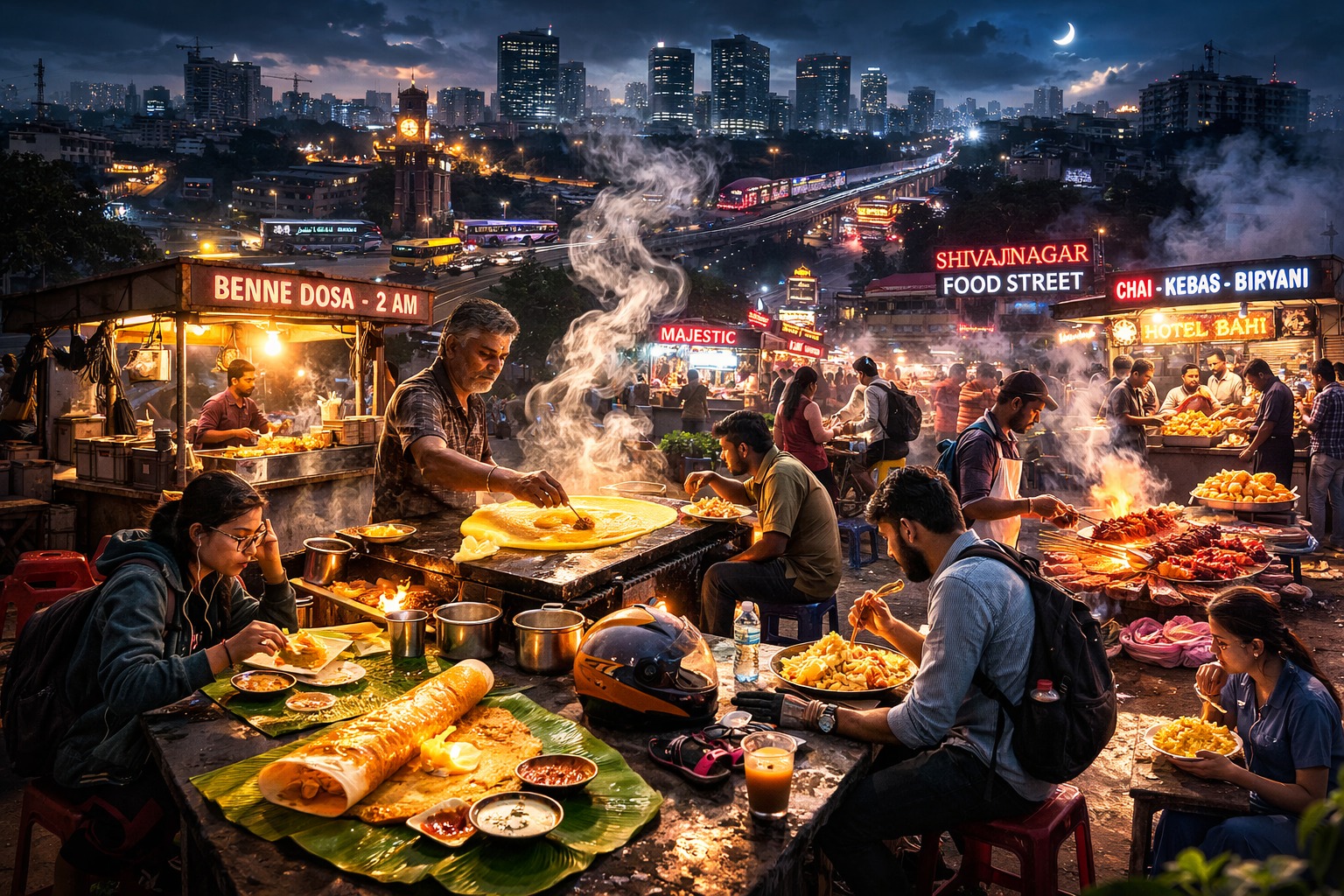
At 2 am, a benne dosa eaten beside a roadside cart feels almost meditative. The cook works with unhurried confidence, ladles moving in familiar circles, butter melting into the surface of the dosa. There is comfort in watching a process that does not change, no matter how unstable the day has been.
People eat standing up, phones in pockets, shoulders relaxed. There are no introductions and no questions. The shared understanding is simple. Everyone here is awake because they have to be, or because sleep has refused to come.
Majestic magic
Near Majestic, the late-night eateries don’t just serve food; they carry the weight of transit and wait. Start at Port of Pavilion on 1st Main Road, a name that’s been around for years and still draws the faithful. Its Chicken Ghee Roast has become something of a signature dish – rich and unapologetic. This is not a place for restraint. It is a place for indulgence. But the real coastal calling lies just around the corner.
Up on the 1st Floor of Sujatha Complex, 1st Cross Road, sits Fishland, a coastal Karnataka canteen with retro interiors, has beckoned foodies for decades. The deal? A fish thali for Rs 130. That’s not all. Wait till you go teeth-deep into crab, clams and more seafood fare the menu.
Add a masala-fried pomfret and some prawn fry and Majestic suddenly feels less like a transit point and more like a destination. The best part? Almost anywhere in Majestic, you can have a satisfying meal for under Rs 200, a rarity in a city where menus increasingly flirt with three digits before you’ve blinked.
And when the spice settles, the adventure continues. A short hop away is Achal Cashew Centre (2, 5th Main), a treasure trove for snackers and shoppers.
Shivajinagar style
If you want to see Bangalore wide awake, head to Shivajinagar after dark. With street food smoke curling into the night, hawkers haggling at full throttle and crowds weaving through lanes, his place refuses to sleep. No wonder many hail it as the “heart of Bangalore” that keeps going till 3–5 am.
This is not curated dining. Here it is raw, pulsating chaos. Hotel Prince is known for its meat curries. At Hamza Hotel, wedding-style biryani arrives heaped and fragrant. Then there are the bakeries, Kausar and Bilal, where khova naan and other sweet temptations disappear as quickly as they’re stacked.
Over at Savera Tea Centre, chai flows steadily while kebabs and sev puri make the rounds at nearby stalls. And if you’re chasing pure street drama, walk into the lanes around Iqbal Dressed Chicken Centre.
Here, juicy kebabs meet idiyappams; string hoppers ready to mop up every drop of flavour. Tandoors sizzle, horns blare, and plates of boti, quail and rolls move fast. Prices range from Rs 10 to Rs 100 per plate, making it a budget-friendly feast; if you can navigate the crush of the crowd. Shivajinagar at night isn’t polished. It isn’t curated. It’s crowded, loud, fragrant and fiercely alive.
Life on different clocks
What makes these spaces endure is not just accessibility. Late night food joints offer emotional neutrality. You can arrive tired, restless, or overstimulated, and no one demands a version of you that feels put together. Eating becomes a small act of care, a way to tell yourself that the night is survivable. The repetition matters. The same order, the same stall, the same plastic chair create a sense of control when schedules and sleep cycles feel unreliable.
Bangalore’s nocturnal food culture also reflects the city’s work rhythms. Global clients, flexible hours, and constant digital connection have been reshaped when people are awake and when they rest. As homes grow quiet, kitchens elsewhere stay lit. These afterhours spaces quietly acknowledge that productivity does not always fit into daylight. They make room for people whose lives run on different clocks.
There is resilience in this routine. In eating when the city sleeps, people find moments of stillness and solidarity. The meals are simple, sometimes rushed, sometimes lingering, but always purposeful. They hold the night together until morning returns. In a city where sleep is often postponed, late night food becomes a way of staying human, one familiar plate at a time.