
CM in front
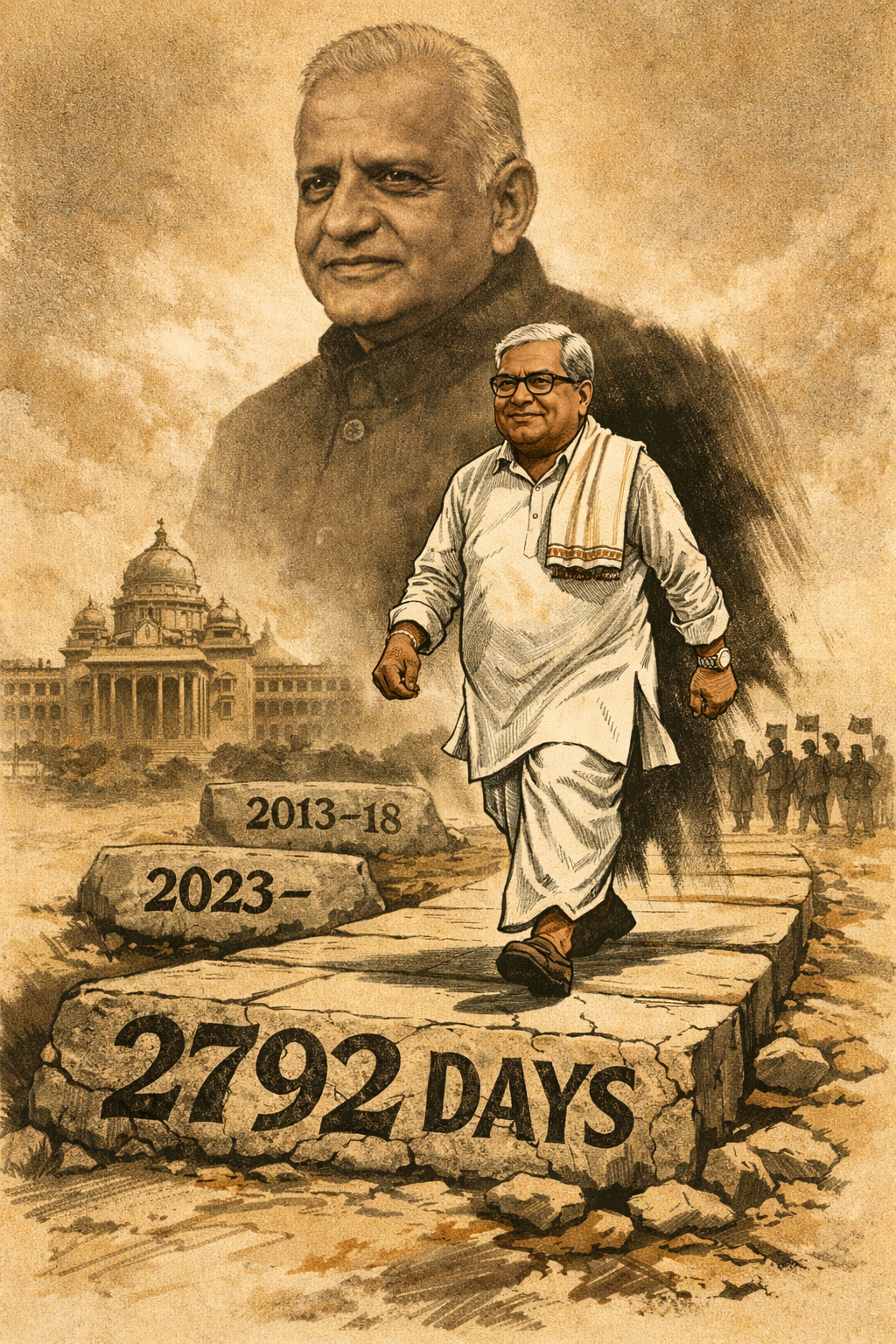
HL: CM in front
Strap: With 2,792 days in office, Siddaramaiah becomes Karnataka’s longest-serving chief minister
Blurb:
Felow Mysurean Devaraj Urs, widely remembered as an icon of social justice and land reforms in Karnataka, served two terms as Chief Minister between 1972–77 and 1978–80. By equalling and now surpassing that benchmark, Siddaramaiah enters rare political territory.
Byline: Ravi Kiran
After days of tense whispers and nervous moments sparked by a simmering leadership tug-of-war within the Congress, Siddaramaiah is now just a step away from scripting a unique chapter in Karnataka’s political history.
In midweek, the 77-year-old Congress veteran equalled the record of fellow Mysurean Devaraj Urs to become the longest-serving Chief Minister of the state in terms of days in office. It’s a mark he will surpass from January 7.
It is a milestone few would have imagined for a leader who spent more than two decades rooted firmly in the “Janata Parivar” and was once among the Congress’ sharpest critics. Yet, in one of Karnataka politics’ most striking turnarounds, Siddaramaiah has matched Urs with 2,792 days in office, spread across two terms.
In his current stint as Chief Minister, which began on May 20, 2023, Siddaramaiah has so far completed 963 days. This adds to the 1,829 days he served during his first term between May 13, 2013 and May 15, 2018; a full five-year tenure that already set him apart. He is the only Chief Minister after Urs to have completed a full term, and over the years, has presented as many as 16 state budgets.
Urs, widely remembered as an icon of social justice and land reforms in Karnataka, served two terms as Chief Minister between 1972–77 and 1978–80. By equalling and now surpassing that benchmark, Siddaramaiah enters rare political territory.
Reflecting on his long journey, Siddaramaiah recently underlined the role of public support in sustaining a political career. “One has to have the blessings of people to be in politics. With the blessings of the people, I have come so far… I will remain in politics until I have the blessings of the people,” he said.
The road travelled
The road to this moment, however, has been anything but straightforward. Born into a poor farmer’s family, Siddaramaiah gave up a career as an advocate to pursue politics, inspired by the socialist ideals of Dr Ram Manohar Lohia.
He began at the grassroots as a taluk board member before making his Assembly debut in 1983 from Chamundeshwari constituency in Mysuru on a Lok Dal ticket. He later joined the erstwhile Janata Party.
Electoral setbacks followed. He lost Assembly elections in 1989 and 1999, and the 1991 Lok Sabha election from Koppal. Despite these reverses, Siddaramaiah remained a significant presence in state politics.
A major turning point came with his dramatic exit from the JD(S), where he had earlier served as state unit chief. Critics maintained that he was sidelined as party patriarch Deve Gowda sought to promote his son H D Kumaraswamy.
The ouster left Siddaramaiah at a political crossroads. He spoke openly about “political sanyas”, toyed with returning to legal practice, and ruled out launching a regional party, citing lack of financial muscle. Both the BJP and the Congress attempted to woo him.
In 2005, Siddaramaiah began repositioning himself as a backward classes leader, spearheading AHINDA conventions, an acronym for minorities, backward classes and Dalits, even as Kumaraswamy was emerging as a rising force in JD(S).
A year later, Siddaramaiah took the plunge many once considered unthinkable and joined the Congress with his followers in 2006, citing ideological differences with the BJP.
Earlier opportunities had narrowly slipped away. In 2004, when Deve Gowda became Prime Minister, Siddaramaiah missed out on the Chief Minister’s post and was pipped by J H Patel, in whose Cabinet he served as Deputy Chief Minister. Under both Gowda and Patel, Siddaramaiah held the crucial finance portfolio.
Patience and persistence eventually paid dividends. In 2013, the Congress picked him to lead the state, fulfilling a long-held ambition. A decade later, those same qualities, coupled with blunt political instincts, propelled the nine-time MLA back to the top office in 2023.
Here & now
The record-setting moment comes amid renewed internal rumblings within the ruling Congress. Supporters of Deputy Chief Minister D K Shivakumar have repeatedly pressed for a leadership change, citing a rumoured “power-sharing arrangement” at the time of government formation in 2023. The buzz intensified after the government crossed the halfway mark of its five-year term on November 20.
Midweek, however, Shivakumar sought to play down the speculation, wishing Siddaramaiah “good luck” after the Chief Minister expressed confidence about completing a full five-year term. “Let good things happen. I wish him all the best,” Shivakumar said, adding that there was no confusion within the party and that the media was creating unnecessary noise.
For now, the numbers tell their own story. Amid shifting loyalties, internal murmurs and relentless political churn, Siddaramaiah has outlasted rivals and sceptics alike and secured his place in Karnataka’s political record books.